Maurizo Cattelan’s Olive Tree

Immediate Response

The first thing that catches the eye is the shear size of the sculpture. It’s incredibly tall and has a huge square base. The precision of the edges stands out. The tree seems to be the most attention drawing aspect of the sculpture however there are so many art pieces done of trees and pieces of nature. This brings you to look at the base. Why such a large base for an object normally sculpted with no base?

Objective Despription

This piece is comprised of a scraggly tree upon a massive dirt base. The base is square and at the top the corners are cut fairly sharp. However, as the base nears the ground it thickens and piles at the bottom; taking away the sharpness of the corners. The sculpture is just over 27 feet tall and nearly 17 feet wide on each side of the base.  The sculpture was formed with Olive Tree, earth, water, wood, metal and plastic. The exhibit is placed in the corner of a museum with white walls and a gold ceiling.  There is nothing near the sculpture. It is set aside by itself with no descriptive signs or posters near it.

Technical Decisions


The Work in the World

This piece takes a very ordinary object and puts a very different spin on it. Most people in the world see many trees everyday and look past them without a second glance. However, when people see trees they do not think about the base and how the tree is supported. Trees are vital to life. They give us oxygen to breath, boards to build, logs to burn for heat and sometimes even food to eat. Cutting this tree out of the environment with the dirt with it allows us to take a step back and look at it for how important it is.

The Story it Tells

A tree is fed by its root system. A tree is often over twice as big underground as it is above ground. We rarely see what is underground. A tree cannot survive without its roots and therefor it is unrealistic to display it that way. Just as people cannot thrive without things to motivate themselves and push themselves for greatness. These things can be things such as religion, family and friends, a desire to do good, money and fame or a combination of them. Just as it is unrealistic for us to look a tree separated from its roots it is also unrealistic to look at people and the world for only their actions and external appearance as if they had no roots.
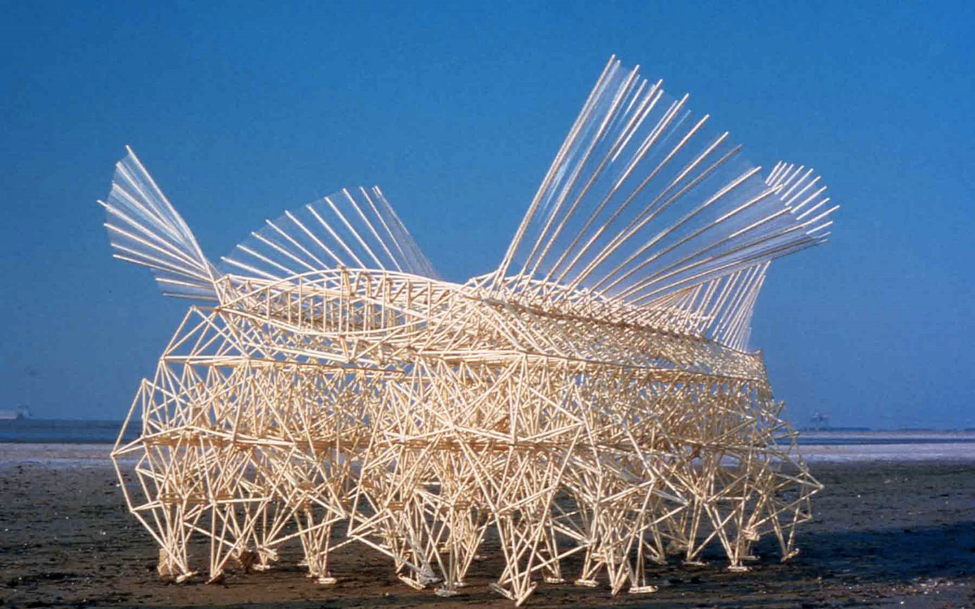
Matt Armo, Strandbeest (Animaris Currens Ventosa)

Matt Armo

ARST 250

Prof. Meiser

1/29/17


Theo Jansen, Strandbeest (Animaris Currens Ventosa)

Immediate Response

The intricacy of the piece immediately stands out to me. It is made of many sections of a PVC pipe material that includes a bunch of feet, a central body, and what appear to be wings. The “animal” seems complex and able to move fluidly much like a human. The object does not bounce while traveling and is able to keep level. This must require precision tolerance of each leg, to ensure the kinetic sculpture won’t move up and down during translational movement. The piece appears very lifelike and moves kind of like an insect with its many legs and two wings.


Objective Description

I see many pieces of PVC piping all zip tied and connected into a sort of structure and lattice. There look to be about 10 legs that each have 5 feet that are able to move and rotate by stepping on the ground to advance the beast and keep it stable and moving forward. There is an arc of pipes on the top to form the back of the animal which is smooth and flat. There are also two long wings on each side that stretch down the entire length of the body and can capture energy out of the wind and allow the piece to move. These wings have PVC supports running through them like bones to give structure and strength to the wings.


Technical Decisions

The artist describes trying to create a new form of life through these animals and he thinks that they will soon be basically independent. The work was made meticulously and with much thought and looks great as an entire piece but was made with limited materials which leads to sloppy looking joints under close inspection. The way the art is presented is that it is released into the world and onto beaches in the Netherlands. The animal is made of inexpensive piping because of its ease of workability, abundance, and cost. The piece is visually appealing to watch and it also leaves lots of room for improvement, which Theo is working hard to implement to make these animals more lifelike.


The Work in the World

This artwork is unique. It combines both art and engineering into one. I could see it combining even more subjects, like biology, and animal behavior because of how lifelike they may become with different technologies. Theo really believes in how alive these sculptures are and delves into their brain and adaptive mechanism systems which run off of the wind. Each animal created is given a species and genus name, like any real living animal found in the wild, which goes to solidify how alive Theo and some others perceive these animals to be. I would compare it to artificial intelligence in a way. Artwork can integrate artificial intelligence and even non-art related AI can be compared to how creators want to see their creations evolve.


The Story it Tells

AI is man’s way of replicating human consciousness using electricity, wires, and circuit boards, much like Theo tries to recreate life and movement in animals, using piping, zip ties, and pressurized bottles. As much as manmade items can appear to mimic life, it is difficult to fully mimic all aspects of movement and consciousness. Theo is trying to create a primitive form of life that might not coincide with all of biology’s definitions of life, but might be able to exist and move independently. This definition of life includes movement, and the knowledge of survival mechanisms, like moving away from water to prevent drowning and anchoring itself in heavy winds.

Owen Parent, The Raw Edge

Owen Parent

Art Report

Sculpture 2

Prof. Meiser

Richard Nonas, The Raw Edge

Immediate Responses:

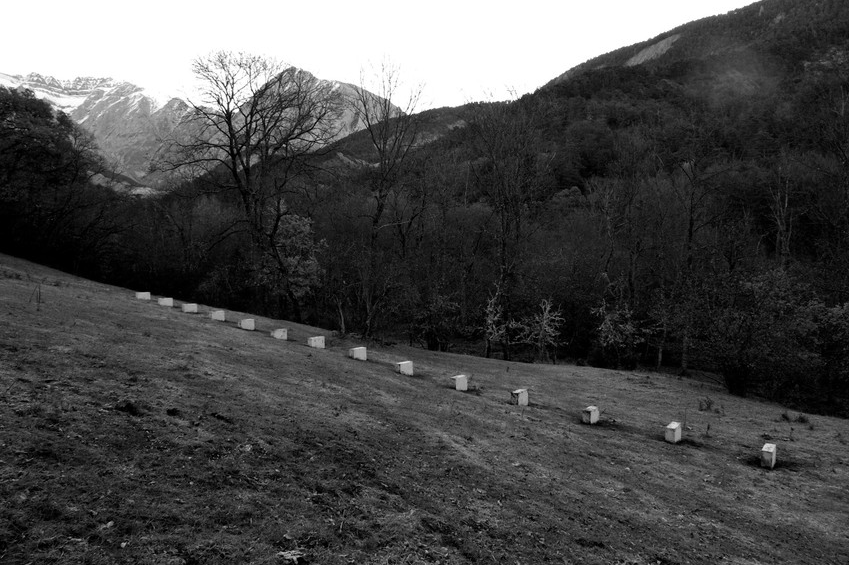
The first time I looked at this piece, it seemed militaristic. I imagined the blocks of stone lining the mountains as soldiers marching to battle. The art seems abrasive and intentionally out-of-place in the rolling hills and mountains. The sharp edges and meticulous spacing of the limestone blocks aren’t natural at all, and the piece’s overall presence is something that is hard to pull your eyes away from. My eyes were immediately drawn to how the piece interacts with its surroundings because the intentionality of the blocks is in such stark contrast with the woods and mountains. Another thing that I noticed was the simplicity of what the piece was, at its core, it is several lines of stones in a field.


Objective Description:

The Raw Edge (2012) is an installation in Viere, Haut Provence, France by Richard Nonas (pictured above). In the piece, 140 blocks of Luberon limestone, each measuring 45x60x20 cm, are arranged in three locations. At the Viere location, the blocks are aligned in two lines that meet at a right angle in the corner of a field. The blocks are arranged in perfectly straight lines and are spaced evenly at distances of about two meters. The piece is nestled in a field amongst snowcapped mountains and thickly wooded forest. The Raw Edge, much like all sculptures and pieces of installation art, changes as the perspective of the viewer changes.


Technical Decisions:

The material choice in The Raw Edge shows the connection between the artwork and its surroundings. The blocks are made of Luberon limestone, which comes from the Luberon mountain range in southeastern France. This means that the artwork is actually made out of the same material that the surrounding mountains are made out of. The lines in this piece allow the eyes to move incrementally along each repeated block of limestone. The most interesting thing about the lines related to eye movement in this piece is that it does not only have to be eye movements, viewers can actually move through and around the art.


The Work in the World:

In a statement about the piece, Nonas referred to the Nazca Lines in South America, Egyptian Obelisks and Australian Dreamlines as some of the most “direct, simple and immediate marking of human thought onto complex and natural reality.” In some ways, Nonas is emulating these ancient cultural, religious, and artistic works through The Raw Edge. He appreciates the simplicity of straight lines installed in nature by humans because it is a reference to ancient methods of claiming land and honoring the deceased.


The Story it Tells:

After looking into this piece of art more deeply for a period of time, my impressions completely changed from what they were when I first saw it. Initially, I saw the work as abrasive and out of place, however now I see that this piece is heavily inspired by the history of many civilizations across the world. The primitive methods used to create the blocks could have been used thousands of years ago just like some of the world’s early civilizations did. The title of the piece speaks to its almost primitive and “raw” nature, and even though it is raw, the precision with which it is constructed and aligned is elegant.


Selecting an artist for the Art Report and Artist Presentation

Please select an artist from the list that Professor Meiser put together on Google Docs

Requirements:

  • The artist should be contemporary (still living).
  • The artist should work primarily in a three-dimensional medium such as sculpture, kinetic art, installation, etc.
  • Please choose an artist who you are not yet familiar with.

Once you have made your selection, add the artist’s name to this document—each student should choose a different artist and selections will be made on a first-come-first-serve basis.  

Published
Categorized as News