Naomi Malone, Matrioska

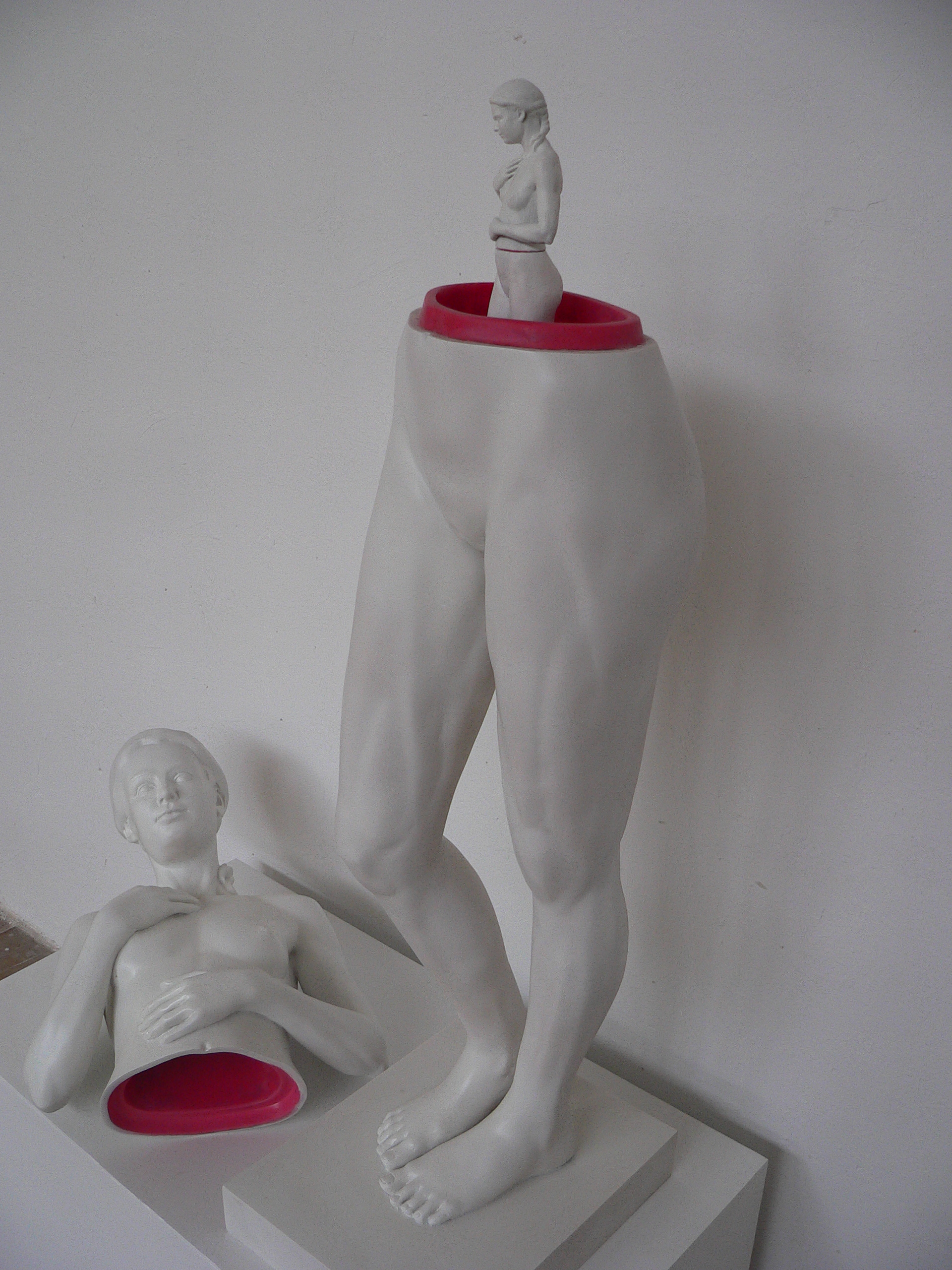
Matrioska, Polyester resin, plaster komposite, 2010, Monika Horcicova

  1. Immediate Response

      When I first looked at this sculpture, I thought about the idea of your true, authentic self being under what you portray yourself to be. Like the little version of herself of her soul and who she is at her core. I also find it interesting how she uses hot pink to contrast the pale porcelain color of the rest of the sculpture. I think the poses on the bigger statue and the mini statue, although the same, portray different emotions. The bigger upper half that’s lying on the ground looks almost shocked or alarmed. Her eyes are wide and she stares off into space, facing the audience. While the little statue that stands in the legs of the bigger statue looks down at the bigger upper half of the body. The placement of the arms also adds to it. Like the smaller statue is admiring or reminiscing.

      2. Objective Description

      The sculpture consists of two focal points. Both parts of the sculpture are replicas of each other. The piece is made up of a sculpture of a woman holding her stomach and chest. There is a big woman and a small woman, both of them being identical to each other. The bigger woman is cut in half right below her belly button. Her uphalf lies on the ground facing the camera. The legs or lower half of the bigger woman is upright and stands on its feet. The smaller woman sits inside the legs of the bigger woman. The smaller one is a whole form with a pink line in the same place as the cutline on the bigger woman. Both sculptures are porcelain white in color except for the line on the smaller woman and the internal part of the torso and legs of the bigger woman. The internal part of the sculpture is a hot pink color.

      3. Technical Decisions

      The sculpture sits on a pedestal with the legs of the bigger woman and the small woman, standing within the bigger woman’s legs, on a slightly raised pedestal. The torso of the larger woman lies slightly below the pedestal that the legs and smaller woman is on. The sculpture is in a room with, what seems to be, brick flooring and stands against a white wall. I think that the use of a white wall in the background and the sculpture being indoors helps the pink within the piece stand out more. Also, due to the sculpture being against the wall, the piece can’t be observed in the round. The back of the sculpture is hidden.

      4. The Work in the World

      The use of the human body and the stone-like appearance of the sculpture reminds me of sculptures from the Renaissance period. The way Horcicova includes muscle that can be seen beneath the skin reminds me specifically of The David. I’m reminded of that sculpture specifically because over the summer I went on a study abroad trip where we studied Da Vinci and famous pieces made during that art period. I got to see The David in person and got a chance to sketch the sculpture for a little. During this observation, I noticed the muscles that were carved into the stone. Additionally, as a Biomedical Engineer, I focus on the human body a lot during my studies.

      5. The Story it Tells

        I believe that this sculpture depicts the different layers of what makes up a person. The smaller woman that sits inside the bigger woman has a pink line that dissects its midsection, which indicates that the sculpture can be broken up further and another woman lies inside the other, similar to Russian nesting dolls. I interpret the art as depicting how a woman is multifaceted and has many layers. The way that both women pose the same, but seem to be expressing two different emotions furthers my reasoning behind why I interpret this piece the way I do. They may pose the same, but the bigger woman’s upper half looks more taken aback with her eyes wide open. The smaller woman looks down at the bigger torso, holding the same pose, but it looks like she’s reminiscing. I think this shows how there are layers to an expression and, by extension, a person.
        Published
        Categorized as Art Report

        (Student Name), Bondi Beach

        This is an example of a well written Art Report from a previous semester.  Keep in mind that this student was following a slightly different set of instructions–your response will only be about half as long as this example.


        Immediate Response

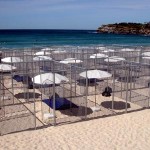
        After finding the piece Bondi Beach by Gregor Schneider in the book Art Now on page 424, I was initially reminded of a large dog pound on an otherwise pleasant beach. I became focused on the limited space provided for the individuals inside and immediately was struck by a sense of claustrophobia along with a confusion as to why people would chose to enter the cages. I found it humorous that inside the extremely small spaces were efforts to instill comfort such as an umbrella, air mattress, and trash bag for convenience. The cages are an eye-sore at a beautiful beach, and an inconvenience for those wishing to relax in a calm area; however, people on the sand do not seem to be daunted by the cages. The people inside are content with their position, and those strolling the beach outside the fences do not even look over at the piece. Schneider’s work is a study of human behavior as well as an aesthetically engaging piece.

        Objective Description

        Gregor Schneider’s Bondi Beach consists of a free-standing connection of metal cages located on a populated public beach. The walls of the cages are twice the height of the average person and are of the standard design used in chain-link fences that are usually used in humane societies. The chain-linked fence allows for those inside to see the ocean as well as those outside to look in on those inside the cages. There are twenty-one cells, each of small dimensions, conveniently equipped with a beach umbrella, air mattress, and trash bag. The installation of these items give those inside a reason to be fully content with their choice of captivation. The number of people inside each cage varies. Some cages are empty, some have one person, and some are overcrowded; however, no one has made the decision to move to the empty cages. Also, there are numerous people freely wandering along the beach outside of the cage.

        Technical Decisions

        Schneider chose to construct his piece out of common materials which helps to depict a sense of “normality” in his work. Instead of constructing an abstract work, he constructed a common object (a cage) and placed it in an odd environment and altered its purpose. Instead of the cages being located at a local humane society, a knowingly unpleasant area, Schneider placed them at a typically beautiful, free location. Also, he replaced the animals expected to be inside with humans. What is unique about Bondi Beach is that the viewer becomes apart of the work. Whether he or she chooses to enter the cage or remain outside does not matter, either choice the individual makes adds to his piece. The fences are not all that is important, the items inside and the colors selected hold great value as well. The white umbrella attempts to add a mirage of tranquility as the blue air mattress mimics the color of the ocean directly outside of the cage to forge a connection with nature.

        The Work in the World

        As mentioned earlier, Bondi Beach is a direct reminder of dog cages at humane societies. They work as a confinement for seemingly “useless” things which add nothing substantial to society. Abandoned dogs that are typically in these types of cages are seen as a nuisance until a human, a species of higher rank, selects the dog to aid his or her life through companionship or more simply: entertainment. Schneider’s piece is also a distinct reminder of prisons or jail cells. However, this work deviates from a jail or prison cell in the sense that people willingly enter these cages. At a quick glance, these cages can remind one of internment camps as well; however, this connection fails for the same reason the jail and prison cell connection fails. These people contained in the cages are not confined, they are not restricted, they freely choose to give up their freedom and abandon their ability to wander for the comfort of modern day items.

        The Story it Tells

        Schneider’s message behind the work is clear: humans have become enslaved by their own creations. He constructed the piece out of previously man-made objects (the fence, umbrella, air mattress, and trash bag.) The man-made fence works as a barrier, the man-made umbrella serves as unnecessary protection, the man-made air mattress becomes luxurious comfort, and the man-made trash bag holds waste from manufactured items. Each of these things symbolizes the ways in which society has over-developed. We produce more than we need, which in turn destroys our natural instincts of survival. We rely on our inventions, even if they rob us of natural beauty, for example the construction of cities and elimination of forests. Even though we may realize we are walking into our own trap, such as the people entering the cages, we cannot deny the comfort that is granted inside.

        Published
        Categorized as Art Report